
 Polski
 English
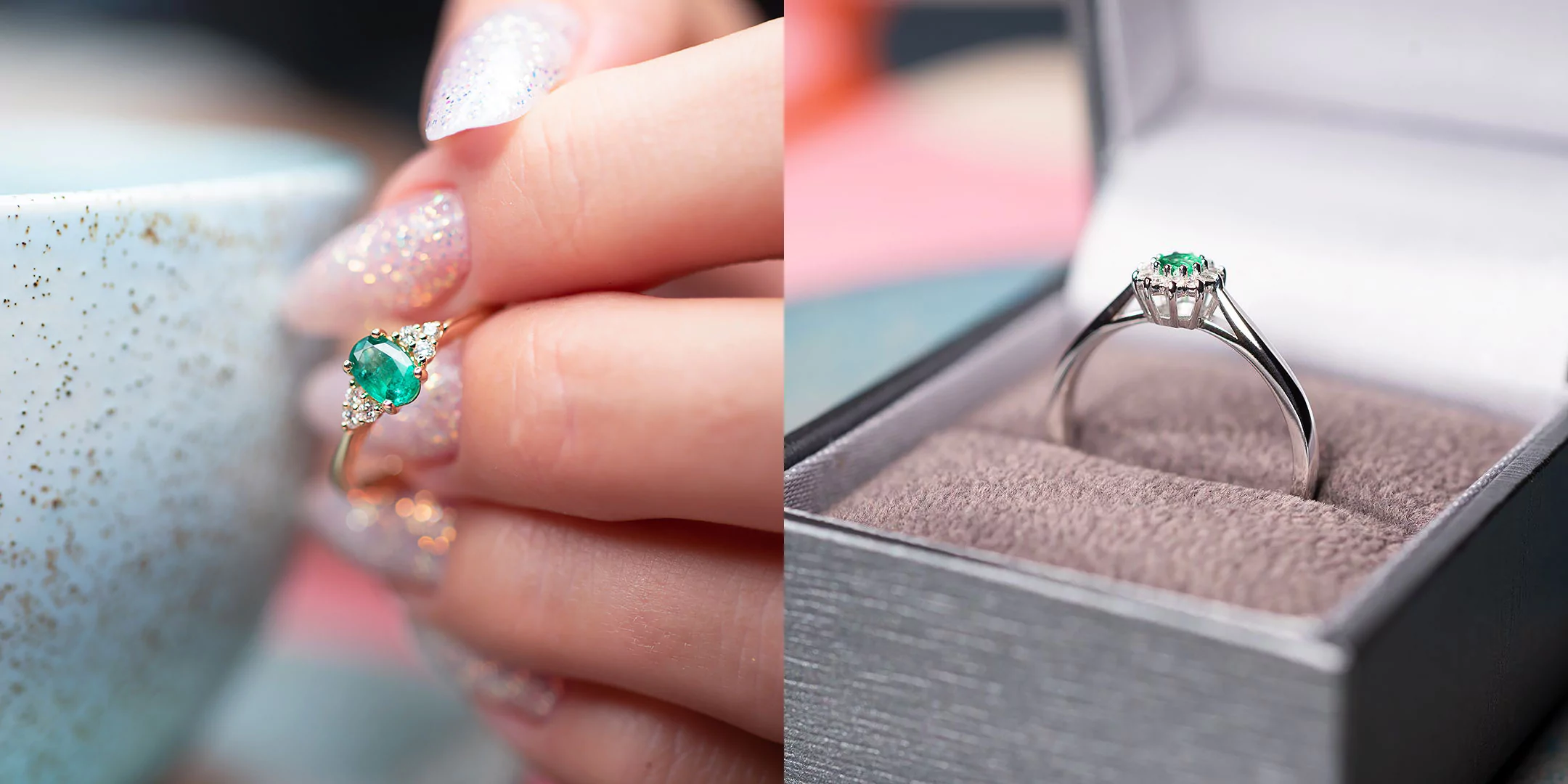
Emerald – one of the most precious gemstones in the world
For thousands of years, emerald has fascinated people with its unique, deep green color. It is considered one of the most precious gemstones alongside diamond, ruby, and sapphire. Its intense hue, rarity, and rich history have made it adorn royal jewels, collectible jewelry, and exclusive rings for centuries.
Today, emerald rings are a symbol of elegance, good taste, and a love for natural beauty. Each stone has an individual character, which means there are no two identical emeralds.
What is an emerald?
Emerald is a variety of the mineral beryl. The same family also includes aquamarine, heliodor, and morganite. The green color of emerald is due to the presence of chromium, vanadium, or both elements simultaneously.
The most valued stones are those with an intensely green color and a subtle bluish hue. High-quality emeralds can reach prices comparable to the best rubies and sapphires.
Where do emeralds come from?
The most famous emerald deposits are located in Colombia, which has been regarded as the world capital of these stones for centuries. Colombian emeralds are known for their exceptionally vivid, deep green color and are particularly valued by jewelers and collectors.
Today, high-quality emeralds are also mined in:
- Zambia,
- Brazil,
- Afghanistan,
- Pakistan,
- Ethiopia,
- Zimbabwe,
- Russia.
Emeralds from different regions of the world can vary in shade of green. Stones from Zambia often have a cooler, more bluish tone, while Colombian emeralds delight with their intense, juicy green.
Emeralds in history
The history of emeralds spans over 4000 years. Ancient Egyptians were already mining these stones in the desert regions of Egypt. The most famous lover of emeralds was Queen Cleopatra, who adorned her insignia and jewelry with them.
In the Middle Ages, it was believed that emeralds possessed extraordinary protective properties and helped maintain balance and wisdom. European royal families collected emeralds for centuries, which can still be admired in museums and treasuries around the world.
One of the most famous emeralds is the so-called “Devonshire Emerald,” weighing over 1300 carats. It is one of the largest and most valuable jewelry emeralds preserved to this day.
Why do emeralds have inclusions?
Emeralds are among the stones that almost always have natural inclusions, which are tiny internal structures formed during their formation in nature.
In the world of gemology, emerald inclusions are often referred to as “jardin,” meaning “garden.” They create characteristic patterns resembling delicate branches, wisps, or networks of minerals trapped inside the stone.
Unlike many other gemstones, the presence of inclusions in emeralds is completely natural and widely accepted. Moreover, it is one of the elements confirming the natural origin of the stone.
How is the quality of emeralds assessed?
Similar to other gemstones, several key factors influence the value of an emerald:
Color
The most important criterion is color. The most desirable emeralds have an intense, evenly saturated green.
Clarity
Due to natural inclusions, emeralds are assessed somewhat differently than diamonds. Minor inclusions are completely normal and do not automatically lower the value of the stone.
Cut
A good cut brings out the depth of color and brilliance of the stone. The so-called emerald cut, designed specifically for this stone, is particularly popular.
Carat weight
Larger high-quality emeralds are much rarer than smaller specimens, which is why their value increases rapidly with size.
Interesting facts about emeralds
- The name “emerald” comes from the Greek word “smaragdos,” meaning green stone.
- The largest emerald found weighed over 57 thousand carats.
- Emerald is the traditional stone assigned to May.
- In astrology, it has been associated with harmony, wisdom, and tranquility for centuries.
- In ancient times, it was believed that looking at an emerald rested the eyes and improved concentration.
- High-quality emeralds are often rarer than diamonds of comparable size.
How to care for an emerald ring?
Emerald has a hardness of 7.5 to 8 on the Mohs scale, but the presence of natural inclusions means it requires a bit more care than diamonds.
To maintain the beauty of the stone for many years, it is advisable to:
- remove the ring during household chores and sports,
- avoid strong chemical agents,
- store jewelry separately from other stones,
- clean it gently using a soft cloth and lukewarm water.
With proper care, an emerald retains its unique brilliance for generations.
Emerald as a symbol of love and elegance
For centuries, emerald has symbolized rebirth, hope, harmony, and the durability of feelings. Due to its extraordinary color, it serves as a unique alternative to classic stones used in engagement rings and occasional jewelry.
An emerald ring attracts attention with its unique character and noble green that never goes out of style. It is a choice for those who appreciate natural beauty, timeless elegance, and the uniqueness of real gemstones.